- Français
- |
- Booklist
- |
- Week of Prayer
- |
- Links
- Areopagus - a forum for dialogue
- Academic journals
- Acronyms
- Bible tools
- Bibliographies
- Booksellers and publishers
- Churches
- Canadian church headquarters
- Directory of Saskatchewan churches
- Retreat centres
- Saskatchewan church and non-profit agencies
- Ecumenism.net Denominational links
- Anabaptist & Mennonite
- Anglican
- Baptist
- Evangelical
- Independent episcopal
- Lutheran
- Methodist, Wesleyan, and Holiness
- Miscellaneous
- Mormon
- Orthodox (Eastern & Oriental)
- Para-church ministries
- Pentecostal / charismatic
- Presbyterian & Reformed
- Quaker (Society of Friends)
- Roman & Eastern Catholic
- United and uniting
- Documents of Ecumenical Interest
- Ecumenical agencies
- Ecumenical Booklist
- Ecumenical Dialogues
- Glossary
- Human rights
- Inter-religious links
- Justice & peace
- Lectionaries
- Religious news services
- Resource pages
- Search Ecumenism.Net
- |
- Documents
- Ancient & Medieval texts
- Ecumenical Dialogues
- Interreligious
- Anabaptist & Mennonite
- Anglican
- Evangelical
- Lutheran
- Orthodox
- Reformed & Presbyterian
- Roman & Eastern Catholic
- United & Uniting
- Miscellaneous churches
- Canadian Council of Churches (CCC)
- Conference of European Churches (CEC)
- Interchurch Families International Network (IFIN)
- National Council of Churches in Australia (NCCA)
- Lausanne Committee for World Evangelism (LCWE)
- World Council of Churches (WCC)
- Other ecumenical documents
Church traditions
Documents from ecumenical agencies
- |
- Dialogues
- Adventist-Reformed
- African Instituted Churches-Reformed
- Anglican-Lutheran
- Anglican-Orthodox
- Anglican-Reformed
- Anglican-Roman Catholic
- Anglican-United/Uniting
- Baptist-Reformed
- Disciples of Christ-Reformed
- Disciples of Christ-Roman Catholic
- Evangelical-Roman Catholic
- Lutheran-Mennonite
- Lutheran-Mennonite-Roman Catholic
- Lutheran-Reformed
- Lutheran-Roman Catholic
- Mennonite-Reformed
- Mennonite-Roman Catholic
- Methodist-Reformed
- Methodist-Roman Catholic
- Oriental Orthodox-Reformed
- Orthodox-Reformed
- Orthodox-Roman Catholic
- Pentecostal-Reformed
- Prague Consultations
- REC-WARC Consultations
- Roman Catholic-Lutheran-Reformed
- Roman Catholic-Reformed
- Roman Catholic-United Church of Canada
- |
- Quick links
- Canadian Centre for Ecumenism
- Canadian Council of Churches
- Ecumenical Shared Ministries
- Ecumenism in Canada
- Interchurch Families International Network
- International Anglican-Roman Catholic Commission for Unity and Mission
- Kairos: Canadian Ecumenical Justice Initiatives
- North American Academy of Ecumenists
- Prairie Centre for Ecumenism
- Réseau œcuménique justice et paix
- Week of Prayer for Christian Unity
- Women's Interchurch Council of Canada
- World Council of Churches
- |
- Archives
- |
- About us

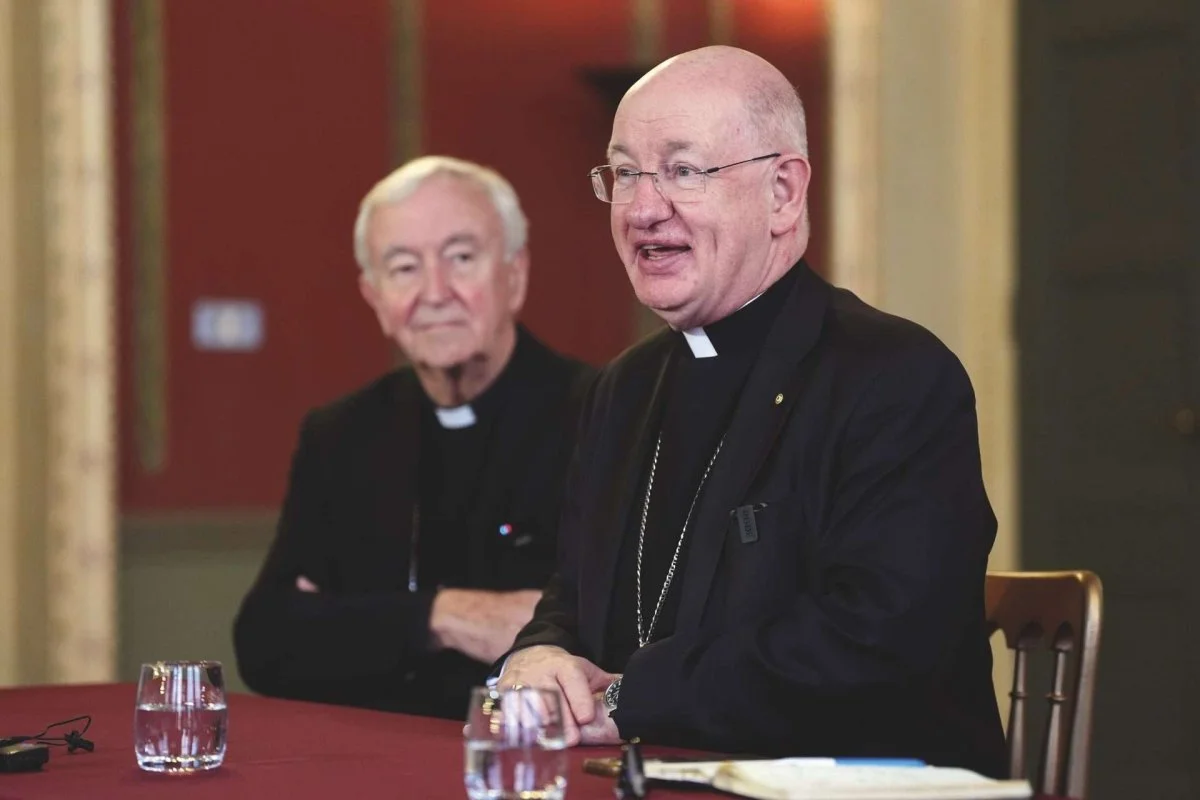
Archbishop Richard Moth, pictured with Cardinal Vincent Nichols. Photo: The Tablet/Alamy/PA.


A paradigm shift for English Catholicism
— Feb. 11, 202611 févr. 2026Richard Moth is due to be installed on Saturday as the twelfth Archbishop of Westminster since the restoration of the hierarchy in 1850. Veteran religious correspondent Clifford Longley argues that it is time for the Church in England and Wales to fundamentally rethink its purpose and mission.
What is the Catholic Church in England and Wales for, exactly? Some might insist existence is enough and no more needs to be said. When the Catholic Church taught extra ecclesiam nulla salus without qualification, that was clearly an imperative. But the Catechism now states: “Those who, through no fault of their own, do not know the Gospel of Christ or his Church, but who nevertheless seek God with a sincere heart, and, moved by grace, try in their actions to do his will as they know it through the dictates of their conscience – those too may achieve eternal salvation” (quoting Lumen Gentium, 16). Paradise is open to all people of sincere goodwill. So why be Catholic? It is not a question that has yet been fully answered.
Read the rest of this article in The Tablet
Even without this irenical gloss, the need for some more concrete raison d’être was certainly in the mind of the original leaders of the English and Welsh Church in 1850. That was when the event, somewhat provocatively known as the Restoration of the Hierarchy, took place. What we might call “the first paradigm”, the original raison d’être, was provided by Nicholas Wiseman, appointed that year as Cardinal and the first Archbishop of Westminster. In his first pastoral letter, flamboyantly called From Out the Flaminian Gate, sent from Rome after the erection of a new hierarchy of bishops had been approved by Pope Pius IX, he wrote: “The great work, then, is complete; what you have long prayed for is granted. Your beloved country has received a place among the fair Churches, which, normally constituted, form the splendid aggregate of Catholic Communion; Catholic England has been restored to its orbit in the ecclesiastical firmament, from which its light had long vanished.”
Wiseman went on to assert: “Till such time as the Holy See shall think fit otherwise to provide, we govern, and shall continue to govern, the counties of Middlesex, Hertford and Essex as Ordinary …”, which could only be taken to mean he was the only valid bishop of those regions. It seemed clear enough to non-Catholic observers what the new organisation was aiming for, and they didn’t like what they saw. In a thundering editorial, The Times denounced it as “Papal Aggression”. It was “one of the grossest acts of folly and impertinence which the Court of Rome has ventured to commit since the Crown and people of England threw off its yoke …”
Did Wiseman really mean it that way? Maybe he did, a bit – but he had to deny it. Realising the damage he had done, he wrote a hasty defence of the creation of the Catholic hierarchy as a piece of administrative tidying-up, mixed with compassion for the poor. In a pamphlet called “An Appeal to the Reason and Good Feeling of the English People”, Wiseman denied that it was his intention or the Pope’s to interfere in any way with the existing legal privileges of the Church of England. The new hierarchy, he explained, replaced the previous system of Apostolic Vicars, senior priests appointed by the Pope with authority over Catholics in their area. This would simply be more efficient. “Nothing to see here”, you might say.
Then, Wiseman defended his use of the name of Westminster in his new title. “Close under the Abbey of Westminster there lie concealed labyrinths of lanes and courts, and alleys and slums, nests of ignorance, vice, depravity and crime, as well as of squalor, wretchedness and disease, whose atmosphere is typhus, whose ventilation is cholera, in which swarms a huge and almost countless population, in great measure, nominally at least, Catholic; haunts of filth, which no sewage committee can reach – dark corners which no lighting-board can brighten. This is the part of Westminster which alone I covet …”
Powerful stuff, which rescued his entire project. Nobody else “coveted” the despised slum-dwelling poor. He was welcome to them. This was the essence of the “second paradigm”, where the raison d’être of the Catholic Church of England and Wales was exclusively to attend to the needs of the Catholic minority, many of whom were refugees from the Irish potato famine. The shift to a “third paradigm” happened more than a century later, after the Second Vatican Council. It was based on the assumption that the Council had opened the way to the reunification of Christianity, and the greatest prize, which seemed at the time to be obtainable, was unity between Anglicans and Roman Catholics. The job of the Catholic Church in England and Wales was to lead and shepherd Anglicans (and other Protestants) back into the fold of the One True Church, reformed and enlightened by their returning presence. Concessions would be necessary, but concessions were possible.
The Anglican-Roman Catholic International Commission (ARCIC) was tasked with studying and resolving doctrinal differences, some, it was discovered, more apparent than real. ARCIC made an astonishing amount of progress, and even the mutual recognition of ministries seemed achievable until, in November 1992, the General Synod of the Church of England voted to approve the ordination of women to the priesthood. It was immediately clear that reunification, at least within the lifetime of anyone then alive, was no longer possible.
All three paradigms, three versions of the title deeds of the Catholic Church in England and Wales, have therefore outlasted their usefulness. A new one is needed: a new strategy, a “fourth paradigm”. Its absence may go some way to explaining the lack of missionary energy that is a discernible feature of contemporary English and Welsh Catholic life. Now, as Wiseman’s eleventh successor takes his seat on the archiepiscopal throne in Westminster Cathedral, it might be the time to address it.
The appointment by Pope Leo XIV of the chairman of the Social Justice committee of the Bishops’ Conference of England and Wales, Richard Moth, might signal what shape the Vatican thinks the fourth paradigm should take. The main purpose of the Catholic Church, of which he will be the de facto leader, can no longer be the defence of the interests of a beleaguered religious minority.
To understand the needs of the present, it is sometimes useful to revisit the past. In 1780, just outside living memory at the time of the Restoration, the most serious rioting in British history took place in London, the anti-Catholic Gordon Riots. Indeed, 70 years later, outrage at the Restoration of the Hierarchy sparked more public disorder across the land, not so severe but more widespread. Both these episodes left an enduring trauma in the Catholic community whose legacy has not completely expired even today. It could still be said in the 1980s that “‘No Popery’ is the residual religion of the English”. Behind the second paradigm was an instinct to cower, avoid the spotlight, support the status quo, defer to the Church of England and be grateful for any crumbs of goodwill from the Establishment or the Royal Family. As a collective psychology, it could be described as being “emotionally needy”, coupled with a vague sense of victimisation and being misunderstood. Great revolutions came to pass – the expansion of the welfare state to fulfil the demands of the Beveridge Report published in 1942, the establishment of the National Health Service in 1948, the dismantling of the British Empire – without the Catholic Church seeming even to notice, at least officially. Why this retreat into disengagement? The remarkable spell of outward-looking leadership under Cardinal Arthur Hinsley, Archbishop of Westminster between 1935 and 1943, was the one exception. But like other English cardinals before and since, he didn’t take the rest of the hierarchy with him. He had tried to push them outside their comfort zone.
Since the Restoration, the Church in England has been essentially inward-looking. When Wiseman returned to London from Rome in 1850, Britain had no welfare state. But it teemed with voluntary societies engaged in welfare and education, largely funded by donations from the public, and most of them had a denominational character. If Catholic orphans were not to fall under the influence of Protestants in faith-based children’s homes or primary schools, for instance, they had to be catered for by Catholic agencies, and the bishops had to set about creating them.
Wiseman himself ordered that building schools should take priority over building churches, which meant that the way would eventually be clear for the emergence of an educated Catholic middle class. It was an extraordinary achievement over the next hundred years, so much so that its success dominated Catholic policy-making long after the need to protect Catholic children from Protestant proselytism had passed. But it strengthened the Catholic instinct to remain in a kind of mental ghetto, and to approach public policy questions solely from the vantage point of Catholic interests. This was, implicitly but fundamentally, a withdrawal from engagement with the common good. And this is the basic flaw in the second paradigm. It may have prioritised the interests of the Catholic section of the population: it just wasn’t “catholic” – meaning universal – enough.
Even the famous intervention by Cardinal Manning in the London dock strike in 1889 had a sectarian edge to it – many of the dockers were Irish Catholics. Nevertheless, that episode signified increasing involvement by the Catholic laity in the Labour Party and trade union movements, a tradition which survives today. The priority was not the pursuit of narrow Catholic interests, but the campaign for social justice for the working class as a whole. What they brought to it, through such bodies as the Young Christian Workers, was a systematic approach based on a “see, judge, act” methodology, using the principles of Catholic Social Teaching as set out in Rerum Novarum in 1891.
Indeed, Catholics have a good claim to be the original owners of the concept of social justice. It was the Italian Jesuit, Luigi Taparelli, who invented the phrase giustizia sociale in 1843. It implied that individuals had a claim, which society had an obligation to meet, on the means necessary for survival. Not meeting those needs was therefore an unpaid debt, an injustice. A starving man may steal a loaf of bread, as Thomas Aquinas taught. A worker may strike for better pay. The law may legislate to ensure every worker has a fair wage. The right to private property was not absolute. And so on. The Church stepped boldly out of the ghetto of narrow Catholic interests in 1996 when every English and Welsh bishop put his name to The Common Good and the Catholic Church’s Social Teaching. As it was unanimous, it had the status of official teaching.
And this was the origin of what might be termed the “fourth paradigm”, the fourth answer to the question with which we began: what should the Catholic Church in England and Wales be for? It is for the promotion of the common good, by every means at its disposal. To do that, it has first to define it. And that is where the work has to start, assisted by a voluminous quantity of official church teaching. The common good means promoting the shared, universal, complete good of every person, whatever their age, race, status, or other characteristic. And what is that “good”? In what does it consist? Pope Benedict XVI answered that in his 2009 encyclical Caritas in Veritate. “The whole Church”, he wrote, “in all her being and acting – when she proclaims, when she celebrates, when she performs works of charity – is engaged in promoting integral human development.” He explained that “authentic human development concerns the whole of the person in every single dimension”, which includes the spiritual, physical, mental, economic, cultural, intellectual, and creative factors that enable every person to reach their full human potential, to which they have a right. Promoting it is what politics is for. To block or impede that goal of human life, whereby people strive to be the best possible version of themselves, is an act of social injustice. When done deliberately by society to an individual, or to a body of individuals identified by a common characteristic, or when it is done by structures or systems such as Communism or capitalism, it is a social injustice. To be denied those opportunities is a form of poverty, and removing such obstacles calls for “the preferential option for the poor”. Social justice needs to be rescued from a partisan spirit of advancing one person’s interests at the expense of another. The key word is “common”. People are hungry for such a comprehensive, inclusive humanistic vision.
Though it draws heavily on Biblical sources, its roots can also be found in classical Greek philosophy, Aristotle especially. As it presupposes that there are both right ways and wrong ways of organising human society – those which can aid human flourishing and those which can harm it – it draws on insights into human nature, by analogy with Natural Law. This means it has a universal appeal, or, to use a software analogy, it is cross-platform. It has a wide overlap with other religious systems which subscribe to the Golden Rule – do as you would be done by. What is perhaps distinctively Christian is its insistence on universality, on there being no exceptions. The word “common” in the phrase “common good” is negated if there is one single person excluded. Matthew 25:40 – “Inasmuch as ye have done it unto one of the least of these my brethren, ye have done it unto me” – is not easily upheld in a strictly utilitarian calculus. The sacrifice of one for the sake of the many can sometimes be more rational, but it is always wrong.
Upholding the common good means advocacy. It means lobbying. It means being political. It means making alliances, employing spin-doctors, lunching with ministers, dining with editors, turning up at Broadcasting House at 6 a.m. or 9 p.m. for that day’s Today or Newsnight programme, making savvy use of social media platforms, being cross-examined by podcasters. Cutting through, to use the jargon. And overcoming the fatal assumption, to which Church groups are particularly prone, that because a thing has been said, it has been done.
This fourth would fulfil all three of the other paradigms, with meaningful adjustments. “Making Britain Catholic again” could be redefined as making Britain a fair and just society, and providing a much needed and much missed sense of moral purpose and vision; protecting Catholic interests would be achieved by protecting the interest of everyone, Catholics included; and doing this in partnership with the Church of England, the other denominations and, wherever possible, other faith leaders.
Anglican social theory was collected and condensed into a systematic whole by Archbishop William Temple (1881-1944), particularly in his highly influential Christianity and Social Order in 1942. He was close to William Beveridge, author of the report which bears his name, but while Beveridge was a Liberal, Temple was happy to be called a socialist. Nevertheless, it was not to Karl Marx that he turned to for answers to the moral questions of the day, but to the Bible. But while Britain was still sufficiently Christian in 1942 for an appeal to Scripture and to the tenets of the Christian faith to be persuasive or even decisive, that time has passed. The Temple test – “Is this appropriate for a Christian society?” – is no longer useful. It is striking how many of the opponents of the assisted dying bill in Parliament, who are known to be Christian believers, nevertheless feel it necessary to preface their remarks by saying they are not speaking from the perspective of Christian faith. This is not the world Temple lived in.
But Catholic Social Teaching does not have that disadvantage. The concept of the common good, allied to universal human dignity (meaning value and respect), is easily understood in a secular world. And Anglican thinkers have been turning in that direction. It does not mean denying the influence of Temple, but it does mean talking in a language which others can still understand. And it can help to address such questions as the limits of human autonomy and the individual person’s duty to the community, and why human rights can never be seen in isolation.
In 2015, the House of Bishops of the Church of England issued a long statement of Anglican social teaching entitled “Who is my neighbour?” which successfully combined the insights of Temple with the influence of Catholic Social Teaching. It began: “All political parties struggle to communicate a convincing vision. People feel detached from politics. Alongside a healthy openness to new ideas, worrying and unfamiliar trends are appearing in our national life. There is a growing appetite to exploit grievances, find scapegoats and create barriers between people and nations.” They called for “a fresh moral vision of the kind of country we want to be”. This is even more relevant now than it was 10 years ago.
The primary role of the Catholic Church in England and Wales must be the defence of social justice and the common good, that is to say, the well-being of the whole of society without exception, regardless of denominational allegiance or the lack thereof. This means making it the major focus of evangelism in the modern era so that loving God and loving one’s neighbour become indistinguishable. That means changing the way it works, including working far more closely with ecumenical partners, locally and nationally. A lone Catholic bishop cannot make newspaper headlines. But the Archbishop of Canterbury can, especially if she has the Archbishop of Westminster by her side. Priorities for the Catholic Church should include expanding the role and resources of such lay-led bodies as Caritas Social Action Network (CSAN), Cafod, and the Centre for Catholic Social Thought and Practice, and looking at ways of collaborating more closely with similar agencies of the Church of England, of other denominations and other faith bodies.
It means growing existing initiatives and helping new ones into life. It means a more sophisticated communications strategy that is proactive rather than defensive. It means developing a model of synodality that harnesses all the latent energy of the Catholic community, together with like-minded allies, in the cause of the common good. Do all this, and politicians and the media will have to listen, as voters certainly will. Richard Moth is arriving at Westminster at a vital moment, when the nation is yearning for a unifying sense of vision and purpose, to show it how it can become the best version of itself.
 Posted: Feb. 11, 2026 •
  Permanent link: ecumenism.net/?p=14798
Categories: Opinion, Tablet • In this article: Anglican, Catholic, Church of England, England
Transmis : 11 févr. 2026 • Lien permanente : ecumenism.net/?p=14798
Catégorie : Opinion, Tablet • Dans cet article : Anglican, Catholic, Church of England, England