- Français
- |
- Booklist
- |
- Week of Prayer
- |
- Links
- Areopagus - a forum for dialogue
- Academic journals
- Acronyms
- Bible tools
- Bibliographies
- Booksellers and publishers
- Churches
- Canadian church headquarters
- Directory of Saskatchewan churches
- Retreat centres
- Saskatchewan church and non-profit agencies
- Ecumenism.net Denominational links
- Anabaptist & Mennonite
- Anglican
- Baptist
- Evangelical
- Independent episcopal
- Lutheran
- Methodist, Wesleyan, and Holiness
- Miscellaneous
- Mormon
- Orthodox (Eastern & Oriental)
- Para-church ministries
- Pentecostal / charismatic
- Presbyterian & Reformed
- Quaker (Society of Friends)
- Roman & Eastern Catholic
- United and uniting
- Documents of Ecumenical Interest
- Ecumenical agencies
- Ecumenical Booklist
- Ecumenical Dialogues
- Glossary
- Human rights
- Inter-religious links
- Justice & peace
- Lectionaries
- Religious news services
- Resource pages
- Search Ecumenism.Net
- |
- Documents
- Ancient & Medieval texts
- Ecumenical Dialogues
- Interreligious
- Anabaptist & Mennonite
- Anglican
- Evangelical
- Lutheran
- Orthodox
- Reformed & Presbyterian
- Roman & Eastern Catholic
- United & Uniting
- Miscellaneous churches
- Canadian Council of Churches (CCC)
- Conference of European Churches (CEC)
- Interchurch Families International Network (IFIN)
- National Council of Churches in Australia (NCCA)
- Lausanne Committee for World Evangelism (LCWE)
- World Council of Churches (WCC)
- Other ecumenical documents
Church traditions
Documents from ecumenical agencies
- |
- Dialogues
- Adventist-Reformed
- African Instituted Churches-Reformed
- Anglican-Lutheran
- Anglican-Orthodox
- Anglican-Reformed
- Anglican-Roman Catholic
- Anglican-United/Uniting
- Baptist-Reformed
- Disciples of Christ-Reformed
- Disciples of Christ-Roman Catholic
- Evangelical-Roman Catholic
- Lutheran-Mennonite
- Lutheran-Mennonite-Roman Catholic
- Lutheran-Reformed
- Lutheran-Roman Catholic
- Mennonite-Reformed
- Mennonite-Roman Catholic
- Methodist-Reformed
- Methodist-Roman Catholic
- Oriental Orthodox-Reformed
- Orthodox-Reformed
- Orthodox-Roman Catholic
- Pentecostal-Reformed
- Prague Consultations
- REC-WARC Consultations
- Roman Catholic-Lutheran-Reformed
- Roman Catholic-Reformed
- Roman Catholic-United Church of Canada
- |
- Quick links
- Canadian Centre for Ecumenism
- Canadian Council of Churches
- Ecumenical Shared Ministries
- Ecumenism in Canada
- Interchurch Families International Network
- International Anglican-Roman Catholic Commission for Unity and Mission
- Kairos: Canadian Ecumenical Justice Initiatives
- North American Academy of Ecumenists
- Prairie Centre for Ecumenism
- Réseau œcuménique justice et paix
- Week of Prayer for Christian Unity
- Women's Interchurch Council of Canada
- World Council of Churches
- |
- Archives
- |
- About us

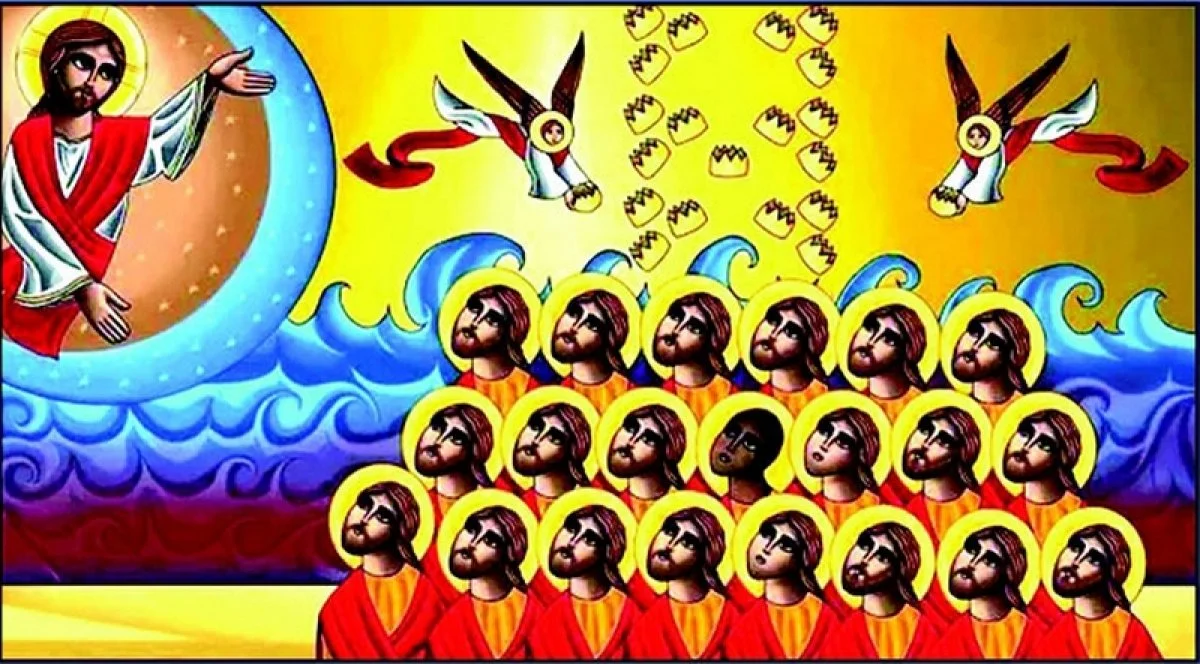
An icon honouring the 21 Coptic Christian Martyrs of Libya killed by ISIS in 2015. The Christian construction workers who were killed for their faith were canonized as martyrs and saints by the Coptic Orthodox Church. In 2023, Pope Francis added these 21 martyrs to the Roman Martyrology. This ecumenical gesture, announced alongside Coptic Pope Tawadros II, highlights their shared martyrdom and sacrifice as a 'baptism of blood'.
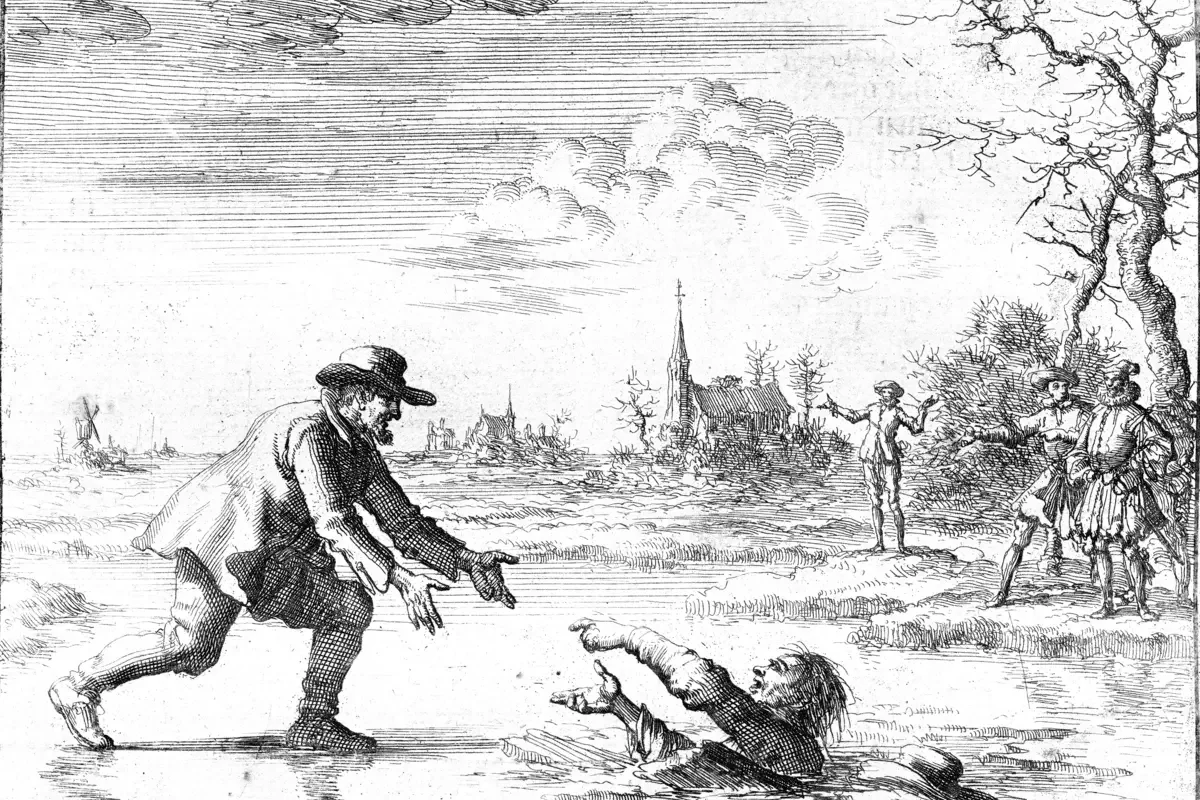
The famed drawing, once presented to Pope Benedict XVI, of 16th century Anabaptist martyr Dirk Willems rescuing his Catholic pursuer who had fallen through a thin sheet of ice. Willems was recaptured and later executed for being rebaptized. Photo: Wikimedia Commons.
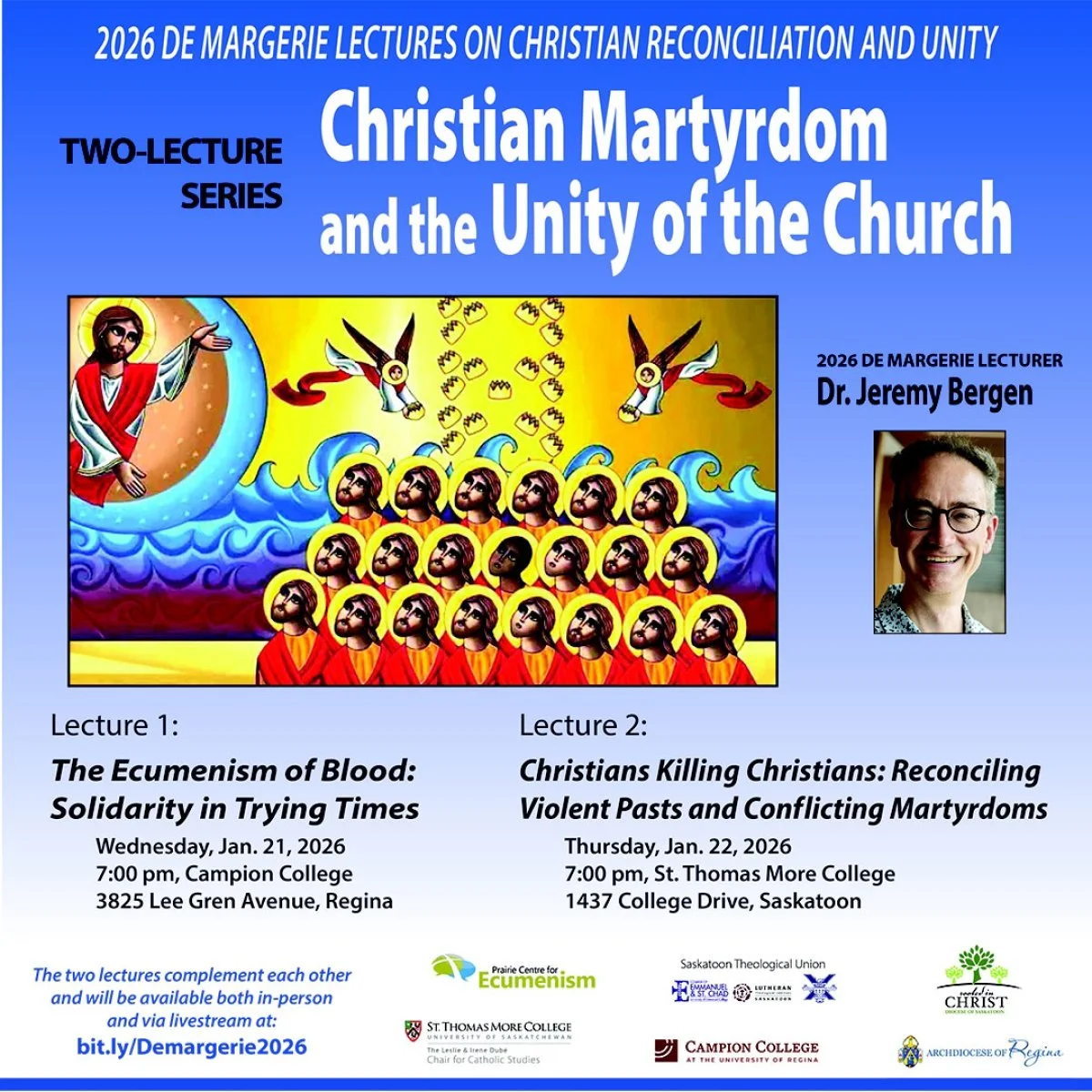
De Margerie Lectures 2026: Christian Martyrdom and the Unity of the Church. (2026)
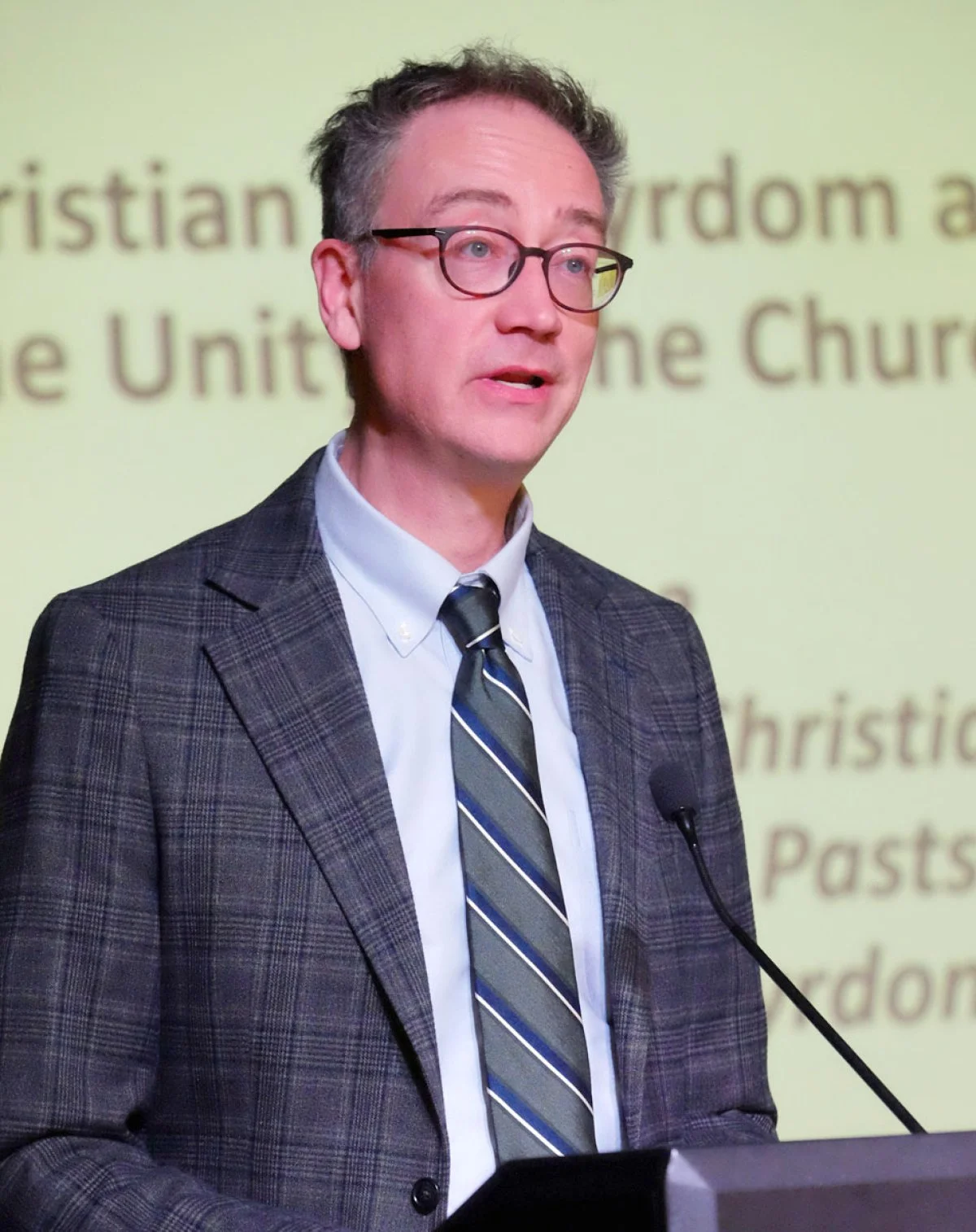
The De Margerie Series for Christian Reconciliation and Unity 2026 lecturer was Dr. Jeremy Bergen, Associate Professor of Religious Studies and Theological Studies at Conrad Grebel University College, University of Waterloo. Photo: Kiply Lukan Yaworski, Catholic Saskatoon News. (22 Jan. 2026)
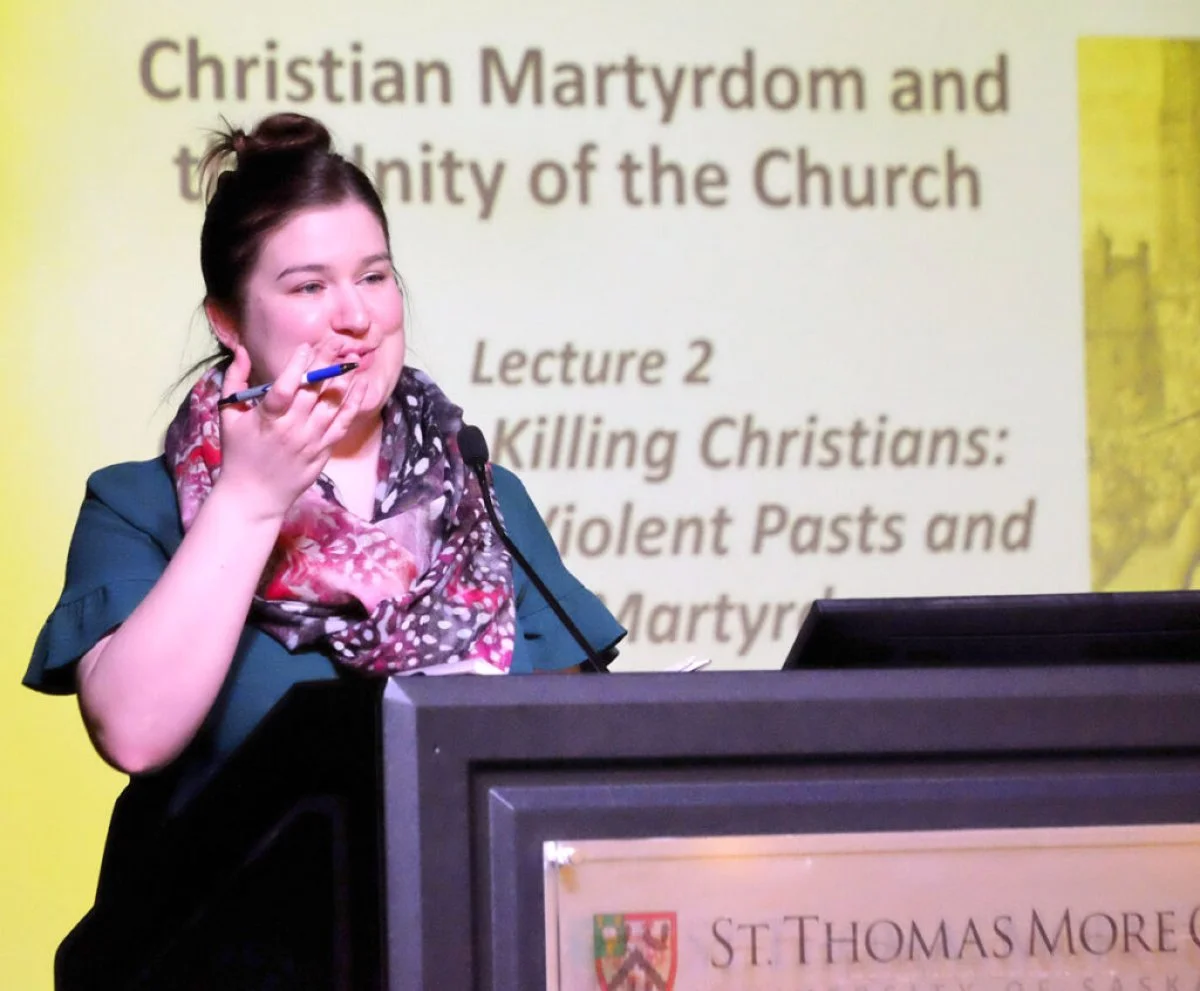
Celeste Woloschuk of the St. Thomas More College Campus Ministry team opened the De Margerie Lecture in Saskatoon with words of welcome. Photo: Kiply Lukan Yaworski, Catholic Saskatoon News. (22 Jan. 2026)
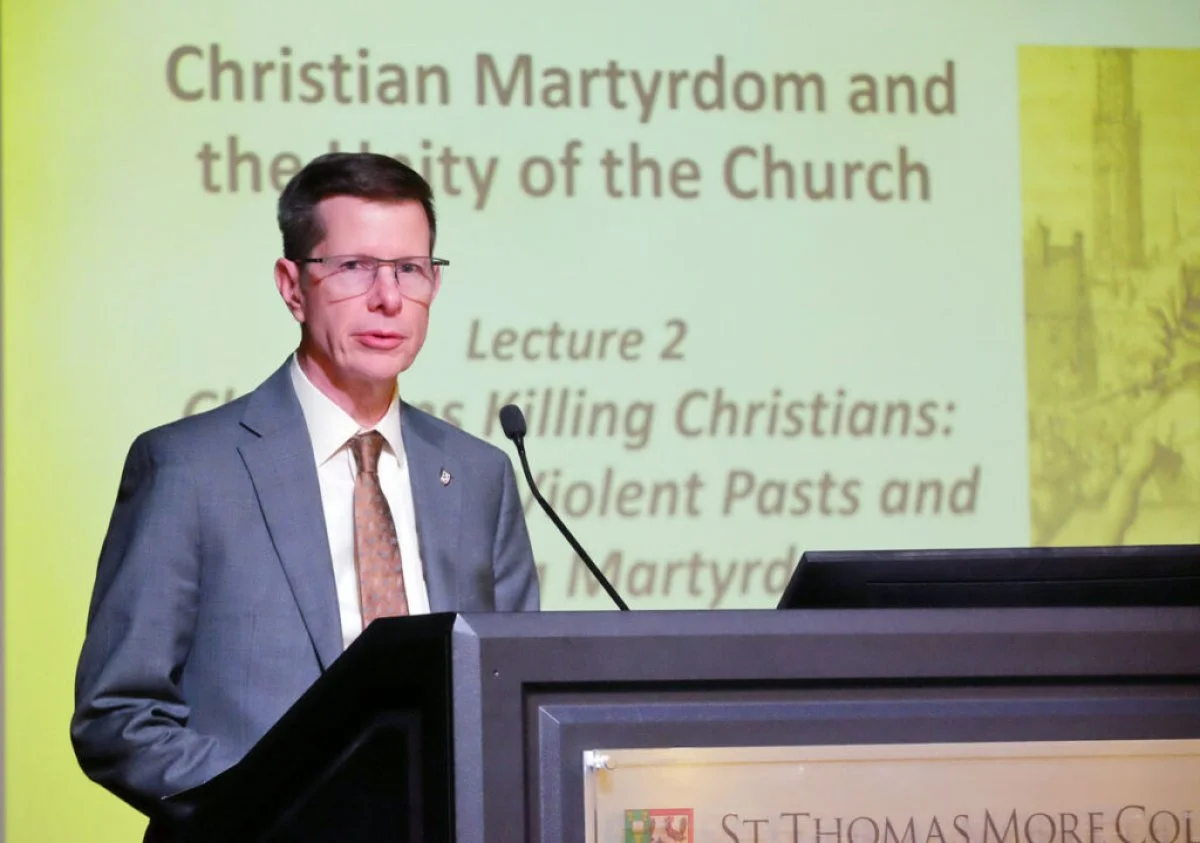
President Dr. Carl Still brought greetings on behalf of St. Thomas More College during the 2026 De Margerie lectures. Photo: Kiply Lukan Yaworski, Catholic Saskatoon News. (22 Jan. 2026)
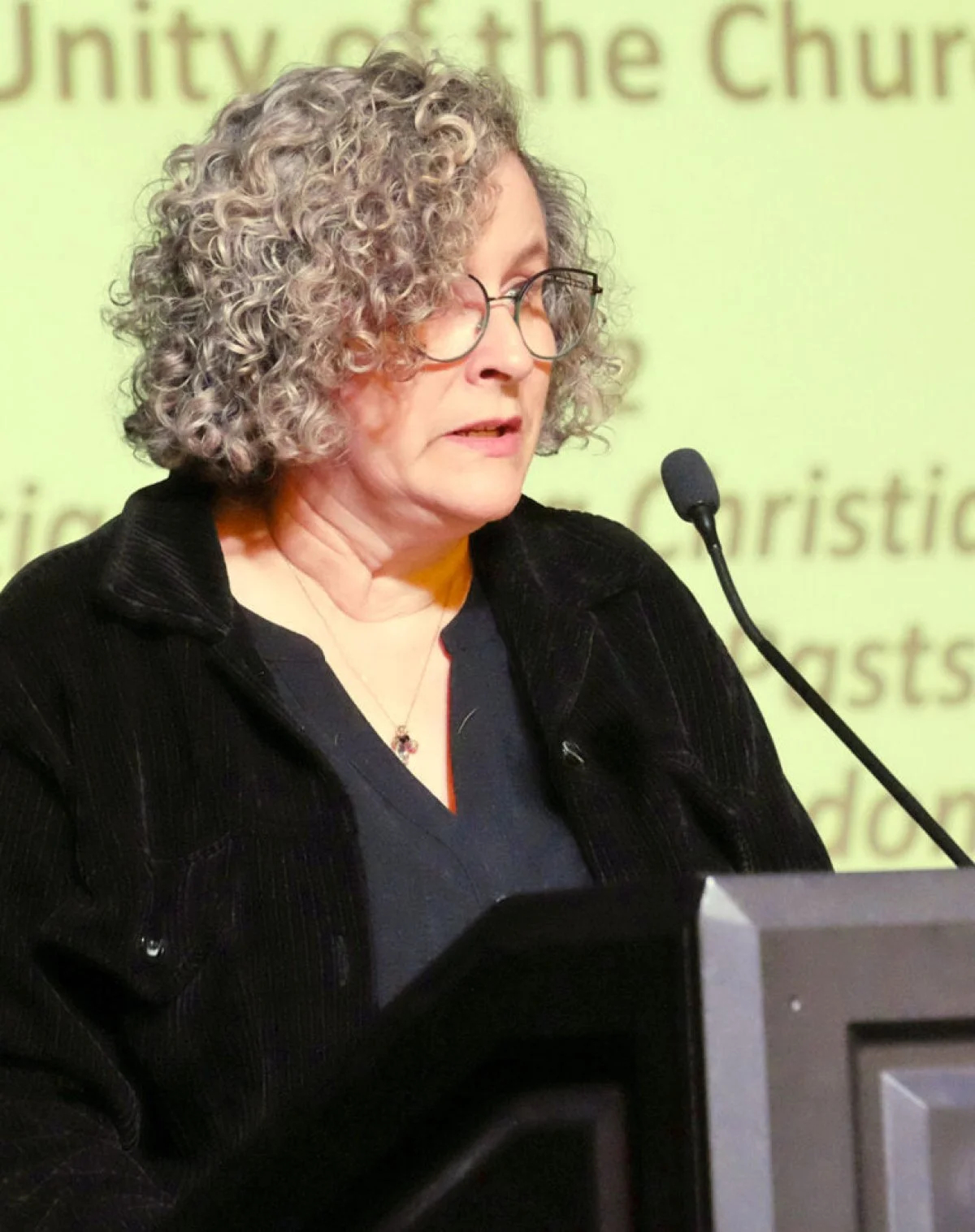
Cathryn Wood of the Prairie Centre for Ecumenism introduced the 2026 De Margerie speaker. Photo: Kiply Lukan Yaworski, Catholic Saskatoon News. (22 Jan. 2026)
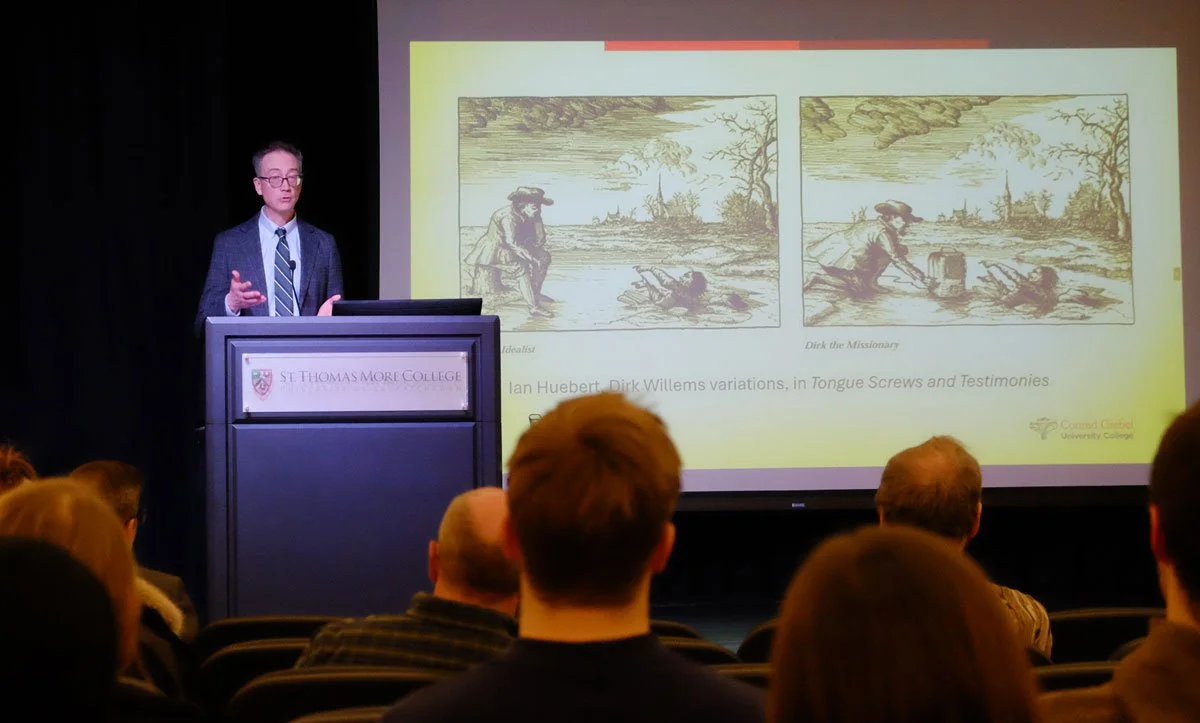
The 2026 De Margerie lecturer, Dr. Jeremy Bergen, has written on church apologies, martyrdom, ecclesiology, ecumenism, the Holy Spirit, and Mennonite theology, and is currently completing a book on Christian martyrdom and the unity of the church for Baylor University Press. Photo: Kiply Lukan Yaworski, Catholic Saskatoon News. (22 Jan. 2026)


Martyrdom, reconciliation and unity explored in this year’s De Margerie Series
— Jan. 17, 202617 janv. 2026Two talks in Saskatchewan during the Week of Prayer for Christian Unity will explore, first, how martyrdom has, time and again, served as a resource for ecumenism, and then how the history of Christians killing Christians can be reckoned with to engender reconciliation and greater unity in the future.
Dr. Jeremy Bergen is the keynote lecturer for the 2026 De Margerie Series on Christian Reconciliation and Unity, with 7 p.m. local time presentations on Jan. 21 at Regina’s Campion College, and Jan. 22 at Saskatoon’s St. Thomas More College.
Bergen is a professor of religious and theological studies at Conrad Grebel University College, affiliated with both the University of Waterloo and the Mennonite Church of Canada. His talks will be available both live and via YouTube at www.youtube.com/@stm1936.
The author and former president of the Canadian Theological Society drew attention to how one of Pope Leo XIV’s first prominent ecumenical initiatives was a Sept. 14 service at St. Paul Outside the Walls Basilica commemorating the martyrs and witnesses of the faith during the 21st century. Pope Francis, Pope Benedict XVI and Pope John Paul hosted similar celebrations during their papacies.
“In some ways, the popes have really been at the forefront of highlighting the fact that there is suffering around the world,” said Bergen. “This is a present reality, not only a past reality. And that the Christian tradition of understanding certain sorts of victims of violence as martyrs is something that can be drawn on to transcend the other divisions that exist among churches.”
On multiple occasions, Pope John Paul II spoke about the “ecumenism of martyrs.” Pope Francis popularised the phrase “ecumenism of blood” to signify the harmony that arises among believers of different denominations during periods of persecution and martyrdom. All that ends up mattering is their shared love of Christ.
Bergen will highlight the legacies of specific contemporary martyrs to illustrate this conviction, including the beheadings of 21 Egyptian Coptic Christians on Feb. 15, 2015, by ISIS in Libya.
Pope Francis reacted to the killings by stating, “they only said, ‘Jesus help me.’ The blood of our Christian brothers is testimony that cries out. Be they Catholic, Orthodox, Copts, Lutherans, it doesn’t matter: They’re Christian!”
Eight years later, in 2023, Francis made a significant ecumenical decision by declaring the 21 men would be commemorated by the Catholic Church and listed within the Roman Martyrology.
“There is this idea we can recognise martyrs across barriers,” said Bergen. “Solidarity in suffering is part of why the story of martyrs can be so powerful.”
The academic will caution spectators that martyrdom accounts have also sown disunity throughout history. For example, the story of the late 19th-century Ugandan Martyrs — 22 Catholics and 23 Anglicans — killed in the Kingdom of Buganda “has often been used in very complex and divisive ways around debates about human sexuality, but also about colonialism and post-colonialism.”
Bergen also noted how the “Eucharist ought to be a sacrament of unity, but it is pretty much the most divisive thing among Christians.” His second lecture delves into the differences that have led to Christians killing other Christians, and how this is a history “we have to face squarely.”
Drawing from his Mennonite background, Bergen will tell the story of Dirk Willems, a Dutch Anabaptist martyr who had escaped from prison but turned back to save his pursuer, who had fallen through thin ice while chasing Willems on foot. Willems’ rescue efforts were successful, but he was recaptured, tortured and killed on May 16, 1569, for his beliefs. Catholic authorities killed Willems for being rebaptized because this rejection of his infant baptism was deemed heretical to the Church.
Bergen will share an image of Pope Benedict XVI being presented with an image of Willems by the then-president of the Mennonite World Conference, Nancy Heisey, in 2007.
“I’ll use that as a way to unpack why Dirk Willems has sort of risen to the top as an Anabaptist martyr and why (this moment) offers some keys to reconciliation,” said Bergen.
The De Margerie lectures are a tribute to the late Fr. Bernard De Margerie, a priest of the Diocese of Saskatoon and ecumenical pioneer who co-founded the Prairie Centre for Ecumenism.
Visit the St. Thomas More College YouTube accounts to view Bergen’s presentations: www.youtube.com/@stm1936.
Video live-stream from Regina Jan. 21:
Video live-stream from Saskatoon Jan. 22:
 Posted: Jan. 17, 2026 •
  Permanent link: ecumenism.net/?p=14816
Categories: Catholic Register • In this article: Christian unity, De Margerie Series, Jeremy Bergen, martyrdom, Mennonite, peace, Regina, Saskatoon
Transmis : 17 janv. 2026 • Lien permanente : ecumenism.net/?p=14816
Catégorie : Catholic Register • Dans cet article : Christian unity, De Margerie Series, Jeremy Bergen, martyrdom, Mennonite, peace, Regina, Saskatoon