- Français
- |
- Booklist
- |
- Week of Prayer
- |
- Links
- Areopagus - a forum for dialogue
- Academic journals
- Acronyms
- Bible tools
- Bibliographies
- Booksellers and publishers
- Churches
- Canadian church headquarters
- Directory of Saskatchewan churches
- Retreat centres
- Saskatchewan church and non-profit agencies
- Ecumenism.net Denominational links
- Anabaptist & Mennonite
- Anglican
- Baptist
- Evangelical
- Independent episcopal
- Lutheran
- Methodist, Wesleyan, and Holiness
- Miscellaneous
- Mormon
- Orthodox (Eastern & Oriental)
- Para-church ministries
- Pentecostal / charismatic
- Presbyterian & Reformed
- Quaker (Society of Friends)
- Roman & Eastern Catholic
- United and uniting
- Documents of Ecumenical Interest
- Ecumenical agencies
- Ecumenical Booklist
- Ecumenical Dialogues
- Glossary
- Human rights
- Inter-religious links
- Justice & peace
- Lectionaries
- Religious news services
- Resource pages
- Search Ecumenism.Net
- |
- Documents
- Ancient & Medieval texts
- Ecumenical Dialogues
- Interreligious
- Anabaptist & Mennonite
- Anglican
- Evangelical
- Lutheran
- Orthodox
- Reformed & Presbyterian
- Roman & Eastern Catholic
- United & Uniting
- Miscellaneous churches
- Canadian Council of Churches (CCC)
- Conference of European Churches (CEC)
- Interchurch Families International Network (IFIN)
- National Council of Churches in Australia (NCCA)
- Lausanne Committee for World Evangelism (LCWE)
- World Council of Churches (WCC)
- Other ecumenical documents
Church traditions
Documents from ecumenical agencies
- |
- Dialogues
- Adventist-Reformed
- African Instituted Churches-Reformed
- Anglican-Lutheran
- Anglican-Orthodox
- Anglican-Reformed
- Anglican-Roman Catholic
- Anglican-United/Uniting
- Baptist-Reformed
- Disciples of Christ-Reformed
- Disciples of Christ-Roman Catholic
- Evangelical-Roman Catholic
- Lutheran-Mennonite
- Lutheran-Mennonite-Roman Catholic
- Lutheran-Reformed
- Lutheran-Roman Catholic
- Mennonite-Reformed
- Mennonite-Roman Catholic
- Methodist-Reformed
- Methodist-Roman Catholic
- Oriental Orthodox-Reformed
- Orthodox-Reformed
- Orthodox-Roman Catholic
- Pentecostal-Reformed
- Prague Consultations
- REC-WARC Consultations
- Roman Catholic-Lutheran-Reformed
- Roman Catholic-Reformed
- Roman Catholic-United Church of Canada
- |
- Quick links
- Canadian Centre for Ecumenism
- Canadian Council of Churches
- Ecumenical Shared Ministries
- Ecumenism in Canada
- Interchurch Families International Network
- International Anglican-Roman Catholic Commission for Unity and Mission
- Kairos: Canadian Ecumenical Justice Initiatives
- North American Academy of Ecumenists
- Prairie Centre for Ecumenism
- Réseau œcuménique justice et paix
- Week of Prayer for Christian Unity
- Women's Interchurch Council of Canada
- World Council of Churches
- |
- Archives
- |
- About us

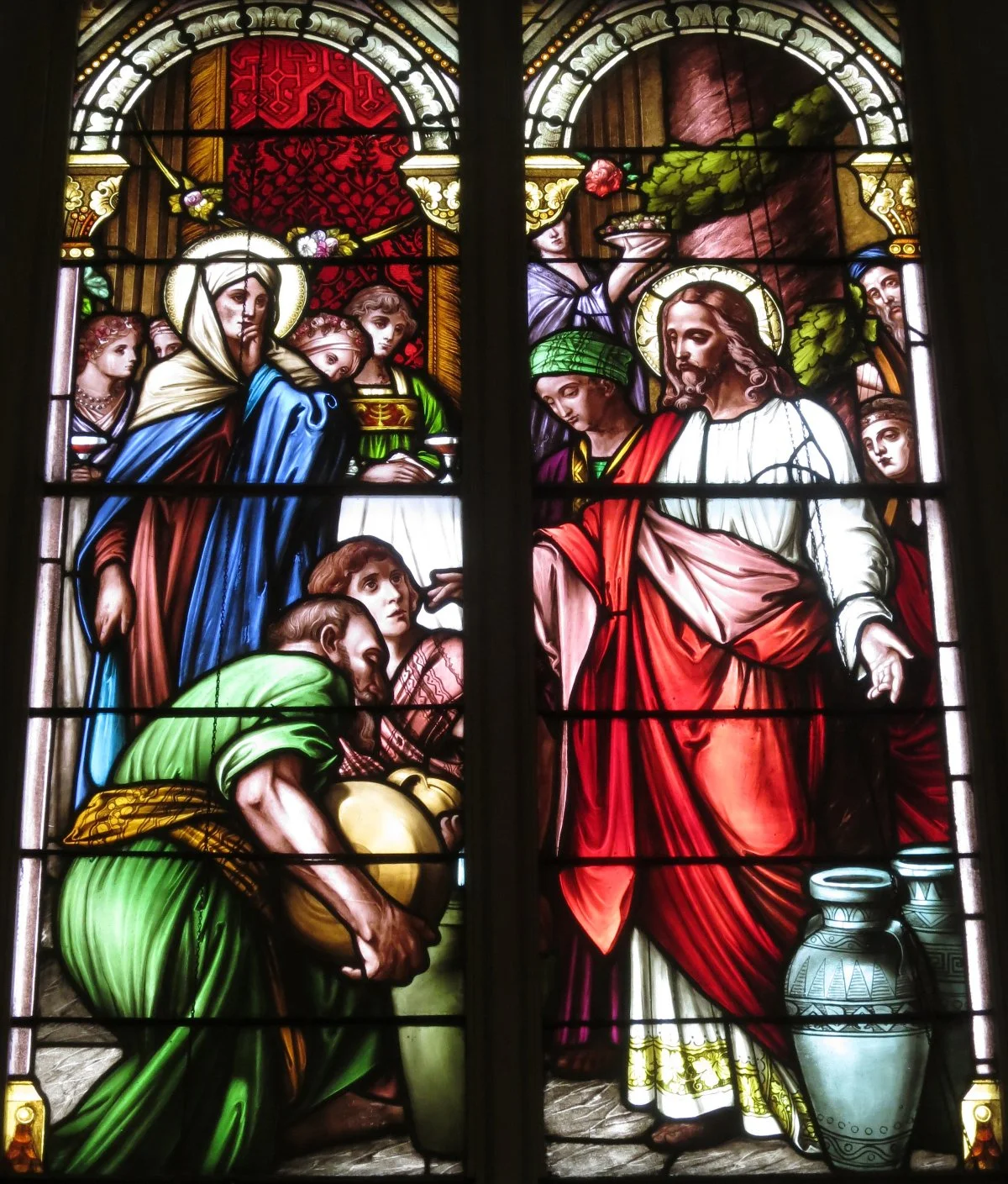
'The Wedding at Cana', stained glass window at St. Mary Catholic Church, Dayton, Ohio. Photo: Wikimedia Commons.


Mary: Mother and Disciple, Not Co-Redemptrix
— Nov. 10, 202510 nov. 2025In Rome, on November 4—the memorial of Saint Charles Borromeo—the Dicastery for the Doctrine of the Faith released Mater Populi Fidelis, a doctrinal note that feels like a gentle breeze amid the stormy seas of ecumenical dialogue. More fully titled Doctrinal Note on Some Marian Titles Regarding Mary’s Cooperation in the Work of Salvation, this document is not just another Vatican pronouncement; it is a thoughtful, Scripture-soaked reflection that reins in exuberant Marian devotions while anchoring them firmly in the mystery of Christ. For some within the broader Christian family, especially Anglicans, this note arrives as a welcome affirmation. It conveys a balanced reverence for the Blessed Virgin, reminding us that ecumenism is not about compromise but about rediscovering shared truths.
As an Anglican layman who continues to study the place of Mary in the life of the Church, I read Mater Populi Fidelis with a sense of delight. Here is a document that does not thunder dogmas but whispers invitations to deeper contemplation. Mary is to be understood as Mother of the Faithful and not Co-Redemptrix, the latter term emerging from popular piety and private revelations. Without dismissing veneration, the note emphasizes Mary’s unique role as Mother while safeguarding Christ’s unambiguously singular mediation. In doing so, it aligns remarkably with Anglican and Orthodox sensibilities, in which Mary is honored as the Theotokos—the God-bearer—but not elevated to a quasi-divine status that mitigates the work of our Savior.
At its core, Mater Populi Fidelis presents a Trinitarian vision of salvation, in which Mary’s cooperation is portrayed not as a parallel power but as a faithful response to God’s grace. Drawing from Scripture—Genesis 3:15, the Wedding at Cana (John 2), the foot of the Cross (John 19)—the document paints Mary as the “privileged witness” to Christ’s life, the new Daughter of Zion who embodies messianic joy. It recalls how early Church Fathers like St. Augustine saw her as a “cooperator” in redemption yet always subordinate to Christ. The note firmly rejects interpretations of “Co-redemptrix” that suggest Mary adds to Christ’s perfect sacrifice, quoting Pope Francis: “There is only one Redeemer, and this title cannot be duplicated.” Instead, it celebrates Mary as “Mother of the Faithful People of God,” a title that resonates with her biblical portrayal as the Woman who intercedes maternally, like at Cana, where she urges, “Do whatever he tells you” (John 2:5).
This Christocentric focus is where the note sings to Anglican ears, and to many others beyond the Anglican fold. In our tradition, shaped by the Book of Common Prayer and the Articles of Religion, Mary is venerated but not invoked in ways that imply mediation apart from Christ. Mater Populi Fidelis mirrors this by stressing that Mary’s intercession is maternal, not priestly—a manifold intercession that points us to Christ, the sole Mediator (1 Tim. 2:5). It is as if the Vatican is saying, “We hear you, let us meet at the Cross, where Mary stands as our shared exemplar of faith.”
The document’s ecumenical tone is explicit. It notes that clarifying Marian titles requires “profound fidelity to Catholic identity while also requiring a particular ecumenical effort.” This is not mere lip service; it is a nod to dialogues like those of the Anglican-Roman Catholic International Commission (ARCIC). In its 2005 agreed statement, Mary: Grace and Hope in Christ, ARCIC explored Mary’s role in salvation history. Certainly many have good questions about the various teachings that different Christian bodies have held about Mary, e.g., Mary as Theotokos, her perpetual virginity, the Immaculate Conception, the Assumption, and her Dormition. The ARCIC statement did not bind these on Anglicans, but attempted to understand the claims, in whole or in part, as coherent with Scripture and whether these center our faith on the grace of Jesus Christ, Mary’s son.
ARCIC emphasised that Mary’s yes at the Annunciation (Luke 1:38) models our response to God, without implying she merits grace independently. Mater Populi Fidelis builds on this, portraying Mary as the “first redeemed,” preserved by Christ’s merits in anticipation, and as the prototype of what God does in all believers. This inclusive understanding of mediation—in which Christ “gives rise to a manifold cooperation” (Lumen Gentium 62)—echoes ARCIC’s call for a new reception of Marian doctrines in light of shared patristic heritage.
The note’s ecumenical breadth extends eastward, drawing deeply from the liturgical and artistic soul of Eastern Christianity (pars. 10–12). Here, Mary’s place unfolds not in abstract theology but in the rhythm of prayer: from fifth-century Marian feasts born in the Byzantine rite to hymnography treasures that pulse with scriptural allegory, evoking awe at the Incarnation. Icons like the Theotokos or Odēgētria—Mary pointing unerringly to her Son—serve as visual sermons, reminding us she’s no rival light but the frame for Christ’s glory. This Eastern lens, inseparable from the early councils, underscores a Mariology of wonder and subordination, in which devotion is mystagogical, leading always to the Trinity. For Anglicans, attuned to the undivided Church’s polyphony, it affirms our supposed via media as a chorus, not a solo.
For Anglicans, receiving this note may be a wonderful a bridge, not a barrier. Our Mariology, often understated, finds affirmation here. Consider how the note highlights Mary’s biblical roots: foreshadowed in the protoevangelium (Gen. 3:15) and perhaps fulfilled in the New Testament as the Woman of Revelation 12. This scriptural depth aligns with an Anglican emphasis on the sufficiency of Scripture. The document’s rejection of titles like “Mediatrix of All Graces,” when they imply a separate repository of grace, avoids the excesses that have historically divided us. Instead, it offers “Mother of Grace” in a carefully qualified sense: Mary as intercessor who readies hearts for the Spirit’s action, for, as the note explains, “Mary’s motherhood in the order of grace must be understood as a help in preparing us to receive God’s sanctifying grace.”
What makes this note particularly attractive is its poetic, pastoral warmth. It does not merely theologize; it kindles wonder. Passages evoke Mary’s “maternal closeness,” as in the tender words of Guadalupe to Juan Diego: “Am I not here, who am your mother?” This stirs Anglican hearts, which cherish the incarnational mystery—God drawing near in human frailty, as in the quiet beauty of the Magnificat at Evensong or the pilgrim’s candle-lit vigil at Walsingham. The note celebrates popular piety, like pilgrimages to shrines, as expressions of trust in God’s mercy reflected in Mary. It quotes the 2007 Aparecida Document from the Roman Catholic bishops of Latin America and the Caribbean: “Love pauses, contemplates the mystery, and enjoys it in silence.” Imagine an Anglican walking the pilgrim path to Walsingham, England’s Nazareth, feeling that same contemplative joy. Here, the Vatican affirms that such devotions are not superstitious but mystagogical, leading deeper into the gospel.
Yet the note is not without challenges for some Anglicans. It affirms dogmas like the Immaculate Conception, which some in our Communion consider pious opinions, not grounded in Scripture or patristic theology, rather than an essential doctrine that must be held to be a faithful Christian. Even so, it frames those still disputed teachings Christologically: Mary’s sinlessness as a sign of Christ’s redeeming power, not her own merit. This invites us to consider these teachings, as ARCIC suggests, without mandating assent. In a divided Anglican world, could Mater Populi Fidelis offer common ground? Evangelicals can appreciate its insistence on Christ’s uniqueness; Anglo-Catholics, its rich patristic and liturgical tapestry.
Ecumenically, this document signals hope. Issued under Cardinal Víctor Manuel Fernández, known for his pastoral approach, and approved by Pope Leo XIV, it builds on Pope Francis’s emphasis on Mary as disciple over titles that risk confusion. As ARCIC said, “Our two communions agree in their witness to the place of Mary in the economy of grace and hope—in what God has done for her in Christ, and what he has done through her for his people.”
In receiving Mater Populi Fidelis, Anglicans might ask: How does this deepen our Marian devotion? Perhaps by incorporating more of her into our preaching—as the first disciple whose faith “continues to become the faith of the pilgrim People of God.” Or by fostering ecumenical prayer, like joint recitations of the rosary with Roman Catholics, focused on biblical mysteries. Ultimately, this note is inviting us to a richer, more Christ-centred love for the Mother of the Lord. In her face, as the note quotes the Aparecida bishops saying, the poor “find God’s affection and love.” In her silence, we find space to hear the Word made flesh. And in her motherhood, we discover that the gospel is not a solitary journey, but a family pilgrimage—led by the One who first called her “woman,” then gave her to us as Mother.
Mother of the Faithful People of God, pray for us.
Simangaliso Magudulela is a Guest Writer. He is a lay minister at St. John’s Church, Johannesburg, and holds a B.Th. from St. Augustine College of South Africa.
 Posted: Nov. 10, 2025 •
  Permanent link: ecumenism.net/?p=14682
Categories: News, Opinion • In this article: Co-redemptorix, Dicastery for the Doctrine of the Faith, Mary, Victor Manuel Fernández
Transmis : 10 nov. 2025 • Lien permanente : ecumenism.net/?p=14682
Catégorie : News, Opinion • Dans cet article : Co-redemptorix, Dicastery for the Doctrine of the Faith, Mary, Victor Manuel Fernández