- Français
- |
- Booklist
- |
- Week of Prayer
- |
- Links
- Areopagus - a forum for dialogue
- Academic journals
- Acronyms
- Bible tools
- Bibliographies
- Booksellers and publishers
- Churches
- Canadian church headquarters
- Directory of Saskatchewan churches
- Retreat centres
- Saskatchewan church and non-profit agencies
- Ecumenism.net Denominational links
- Anabaptist & Mennonite
- Anglican
- Baptist
- Evangelical
- Independent episcopal
- Lutheran
- Methodist, Wesleyan, and Holiness
- Miscellaneous
- Mormon
- Orthodox (Eastern & Oriental)
- Para-church ministries
- Pentecostal / charismatic
- Presbyterian & Reformed
- Quaker (Society of Friends)
- Roman & Eastern Catholic
- United and uniting
- Documents of Ecumenical Interest
- Ecumenical agencies
- Ecumenical Booklist
- Ecumenical Dialogues
- Glossary
- Human rights
- Inter-religious links
- Justice & peace
- Lectionaries
- Religious news services
- Resource pages
- Search Ecumenism.Net
- |
- Documents
- Ancient & Medieval texts
- Ecumenical Dialogues
- Interreligious
- Anabaptist & Mennonite
- Anglican
- Evangelical
- Lutheran
- Orthodox
- Reformed & Presbyterian
- Roman & Eastern Catholic
- United & Uniting
- Miscellaneous churches
- Canadian Council of Churches (CCC)
- Conference of European Churches (CEC)
- Interchurch Families International Network (IFIN)
- National Council of Churches in Australia (NCCA)
- Lausanne Committee for World Evangelism (LCWE)
- World Council of Churches (WCC)
- Other ecumenical documents
Church traditions
Documents from ecumenical agencies
- |
- Dialogues
- Adventist-Reformed
- African Instituted Churches-Reformed
- Anglican-Lutheran
- Anglican-Orthodox
- Anglican-Reformed
- Anglican-Roman Catholic
- Anglican-United/Uniting
- Baptist-Reformed
- Disciples of Christ-Reformed
- Disciples of Christ-Roman Catholic
- Evangelical-Roman Catholic
- Lutheran-Mennonite
- Lutheran-Mennonite-Roman Catholic
- Lutheran-Reformed
- Lutheran-Roman Catholic
- Mennonite-Reformed
- Mennonite-Roman Catholic
- Methodist-Reformed
- Methodist-Roman Catholic
- Oriental Orthodox-Reformed
- Orthodox-Reformed
- Orthodox-Roman Catholic
- Pentecostal-Reformed
- Prague Consultations
- REC-WARC Consultations
- Roman Catholic-Lutheran-Reformed
- Roman Catholic-Reformed
- Roman Catholic-United Church of Canada
- |
- Quick links
- Canadian Centre for Ecumenism
- Canadian Council of Churches
- Ecumenical Shared Ministries
- Ecumenism in Canada
- Interchurch Families International Network
- International Anglican-Roman Catholic Commission for Unity and Mission
- Kairos: Canadian Ecumenical Justice Initiatives
- North American Academy of Ecumenists
- Prairie Centre for Ecumenism
- Réseau œcuménique justice et paix
- Week of Prayer for Christian Unity
- Women's Interchurch Council of Canada
- World Council of Churches
- |
- Archives
- |
- About us

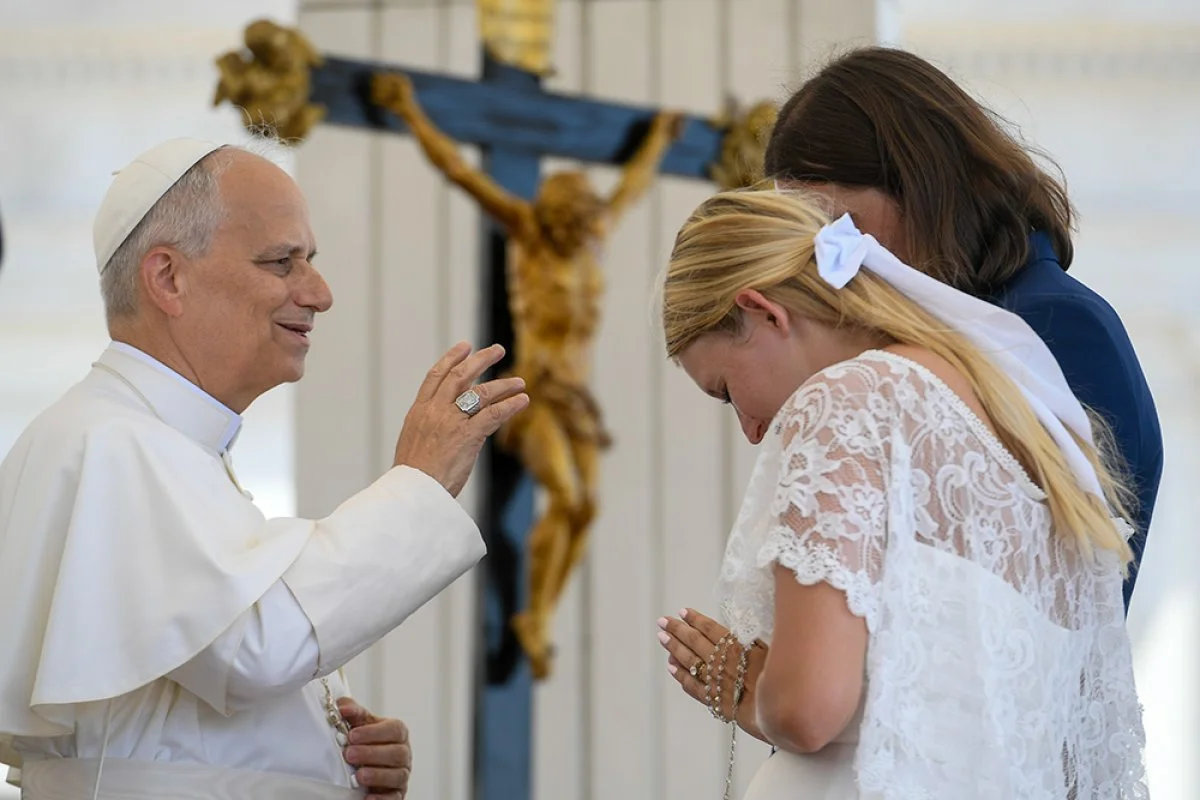
Pope Leo XIV blesses a newlywed couple. Photo: CNS/Vatican Media. (26 June 2025)


Vatican issues sweeping defense of traditional marriage, pushing back on polygamy
— Nov. 25, 202525 nov. 2025Responding to recent questions raised by African bishops concerned about the practice of polygamy, the Vatican issued a sweeping defence of monogamy Tuesday, Nov. 25.
The 40-page doctrinal note “Una Caro (One Flesh): In Praise of Monogamy: Doctrinal Note on the Value of Marriage as an Exclusive Union and Mutual Belonging,” was issued […] by the Vatican’s Dicastery for the Doctrine of the Faith. It offers a far-reaching theological, biblical, and cultural reflection on the Catholic Church’s teaching that marriage is a “unique and exclusive” union between one man and one woman.
The catechism teaches that marriage requires “the unity and indissolubility” of spouses. Una Caro noted that while the church has extensively developed the doctrine of indissolubility of marriage, it said the magisterium has offered “less extensive reflection” on unity.
Unity within a monogamous marriage, the document said, “can be defined as the unique and exclusive union between one woman and one man, in other words, as the mutual belonging of the two, which cannot be shared with others.”
Una Caro then traces the idea of unity in marriage across Scripture, the Church Fathers, medieval and modern theology, as well as more recent magisterial developments to demonstrate the unitive effect of monogamous marriage. Later sections widen the lens to culture, noting how Indian traditions and Hindu literature depict exclusive, lifelong love, and invoking poets like Pablo Neruda and Walt Whitman, to illustrate the enduring human desire for a monogamous love.
Cardinal Víctor Manuel Fernández, prefect of the Vatican’s doctrine office, said at a news conference presenting the document that it was drafted in response to a desire from several African bishops, who minister to communities where polygamy is common, to develop a resource to motivate people towards monogamy.
That the document was drafted to praise monogamy and not condemn polygamy “gives the document a different tone than other documents,” he said.
Still, at several points, the document makes clear that different forms of non-monogamy are incompatible with the church’s concept of unity in marriage.
It said polygamy, adultery, or polyamory, having multiple committed relationships at the same time, “are based on the illusion that the intensity of the relationship can be found in the succession of faces,” but the document emphasised that “multiplying faces in a supposed total union means fragmenting the meaning of marital love.”
“Monogamy is not simply the opposite of polygamy,” it stated. “It is much more, and its deepening allows a conception of marriage in all of its richness and fertility,” which the document said is tied to sexuality but “is not limited to ensuring procreation.”
Drawing from St. Thomas Aquinas, the document stated that monogamy “consolidates the mutual balance between man and woman,” and that there is no room for any form of polyandry, when a woman has two or more husbands, or polygamy, which the document said Aquinas “defines as a form of slavery.”
While the document was prompted by the acute need to expand on the church’s teaching of monogamy for Africa, Fernández said that it also serves to highlight the value of monogamy in societies without polygamy per se, but where infidelity or polyamory is practised in private.
The document stated: “We cannot ignore that in recent decades, in the context of postmodern consumerist individualism, various problems have arisen from an excessive and uncontrolled pursuit of sex, or from the simple denial of the procreative purpose of sexuality.”
“A peculiarity of recent decades is the explicit denial of the unitive purpose of sexuality and of marriage itself. This is especially due to feelings of anxiety, of always being busy, of wanting more free time for oneself, of being constantly obsessed with travelling and discovering new places,” it continued. “As a result, the desire for emotional exchange, for sexual relations themselves, but also for dialogue and cooperation, disappears, as these things are seen as ‘stressful.’ ”
In its review of the magisterium, the document recounts how Pope Pius XI expressed that the mutual formation of spouses could be said to be “the primary cause and reason for marriage.”
“This ‘broadening’ of the meaning of marriage, which goes beyond the narrow meaning that had prevailed until then, as an institution ordered to procreation and the proper education of offspring, paved the way for a deeper understanding of the unitive meaning of marriage and sexuality,” it said.
Una Caro also cited Pope Leo XIII’s defence of monogamy as a “defence of women’s dignity, which cannot be denied or dishonoured even for the sake of procreation.”
“The unity of marriage, therefore, implies a free choice on the part of women, who have the right to demand exclusive reciprocity,” it said.
The Second Vatican Council likewise affirmed that marital union is “all-encompassing” and therefore possible only between two individuals, warning that any “plural” union would threaten the dignity of both spouses who would be forced to “share with others what should be intimate and exclusive, thus becoming like objects in a relationship that demeans their personal dignity,” the note said.
While the document had been developed months ago, Fernández said, its release was delayed to follow the publication of Pope Leo XIV’s apostolic exhortation Dilexi Te, on love of the poor, elements of which were included in the note.
“A particular sign of the couple’s openness to others and the fruitfulness of their charity is manifested in their concern for the poor,” Una Caro stated. “Christians cannot consider the poor merely as a social problem: they are a ‘family matter’. They are ‘one of us.’ “
 Posted: Nov. 25, 2025 •
  Permanent link: ecumenism.net/?p=14692
Categories: NCR • In this article: Dicastery for the Doctrine of the Faith, marriage, polygamy, Victor Manuel Fernández
Transmis : 25 nov. 2025 • Lien permanente : ecumenism.net/?p=14692
Catégorie : NCR • Dans cet article : Dicastery for the Doctrine of the Faith, marriage, polygamy, Victor Manuel Fernández