- Français
- |
- Booklist
- |
- Week of Prayer
- |
- Links
- Areopagus - a forum for dialogue
- Academic journals
- Acronyms
- Bible tools
- Bibliographies
- Booksellers and publishers
- Churches
- Canadian church headquarters
- Directory of Saskatchewan churches
- Retreat centres
- Saskatchewan church and non-profit agencies
- Ecumenism.net Denominational links
- Anabaptist & Mennonite
- Anglican
- Baptist
- Evangelical
- Independent episcopal
- Lutheran
- Methodist, Wesleyan, and Holiness
- Miscellaneous
- Mormon
- Orthodox (Eastern & Oriental)
- Para-church ministries
- Pentecostal / charismatic
- Presbyterian & Reformed
- Quaker (Society of Friends)
- Roman & Eastern Catholic
- United and uniting
- Documents of Ecumenical Interest
- Ecumenical agencies
- Ecumenical Booklist
- Ecumenical Dialogues
- Glossary
- Human rights
- Inter-religious links
- Justice & peace
- Lectionaries
- Religious news services
- Resource pages
- Search Ecumenism.Net
- |
- Documents
- Ancient & Medieval texts
- Ecumenical Dialogues
- Interreligious
- Anabaptist & Mennonite
- Anglican
- Evangelical
- Lutheran
- Orthodox
- Reformed & Presbyterian
- Roman & Eastern Catholic
- United & Uniting
- Miscellaneous churches
- Canadian Council of Churches (CCC)
- Conference of European Churches (CEC)
- Interchurch Families International Network (IFIN)
- National Council of Churches in Australia (NCCA)
- Lausanne Committee for World Evangelism (LCWE)
- World Council of Churches (WCC)
- Other ecumenical documents
Church traditions
Documents from ecumenical agencies
- |
- Dialogues
- Adventist-Reformed
- African Instituted Churches-Reformed
- Anglican-Lutheran
- Anglican-Orthodox
- Anglican-Reformed
- Anglican-Roman Catholic
- Anglican-United/Uniting
- Baptist-Reformed
- Disciples of Christ-Reformed
- Disciples of Christ-Roman Catholic
- Evangelical-Roman Catholic
- Lutheran-Mennonite
- Lutheran-Mennonite-Roman Catholic
- Lutheran-Reformed
- Lutheran-Roman Catholic
- Mennonite-Reformed
- Mennonite-Roman Catholic
- Methodist-Reformed
- Methodist-Roman Catholic
- Oriental Orthodox-Reformed
- Orthodox-Reformed
- Orthodox-Roman Catholic
- Pentecostal-Reformed
- Prague Consultations
- REC-WARC Consultations
- Roman Catholic-Lutheran-Reformed
- Roman Catholic-Reformed
- Roman Catholic-United Church of Canada
- |
- Quick links
- Canadian Centre for Ecumenism
- Canadian Council of Churches
- Ecumenical Shared Ministries
- Ecumenism in Canada
- Interchurch Families International Network
- International Anglican-Roman Catholic Commission for Unity and Mission
- Kairos: Canadian Ecumenical Justice Initiatives
- North American Academy of Ecumenists
- Prairie Centre for Ecumenism
- Réseau œcuménique justice et paix
- Week of Prayer for Christian Unity
- Women's Interchurch Council of Canada
- World Council of Churches
- |
- Archives
- |
- About us

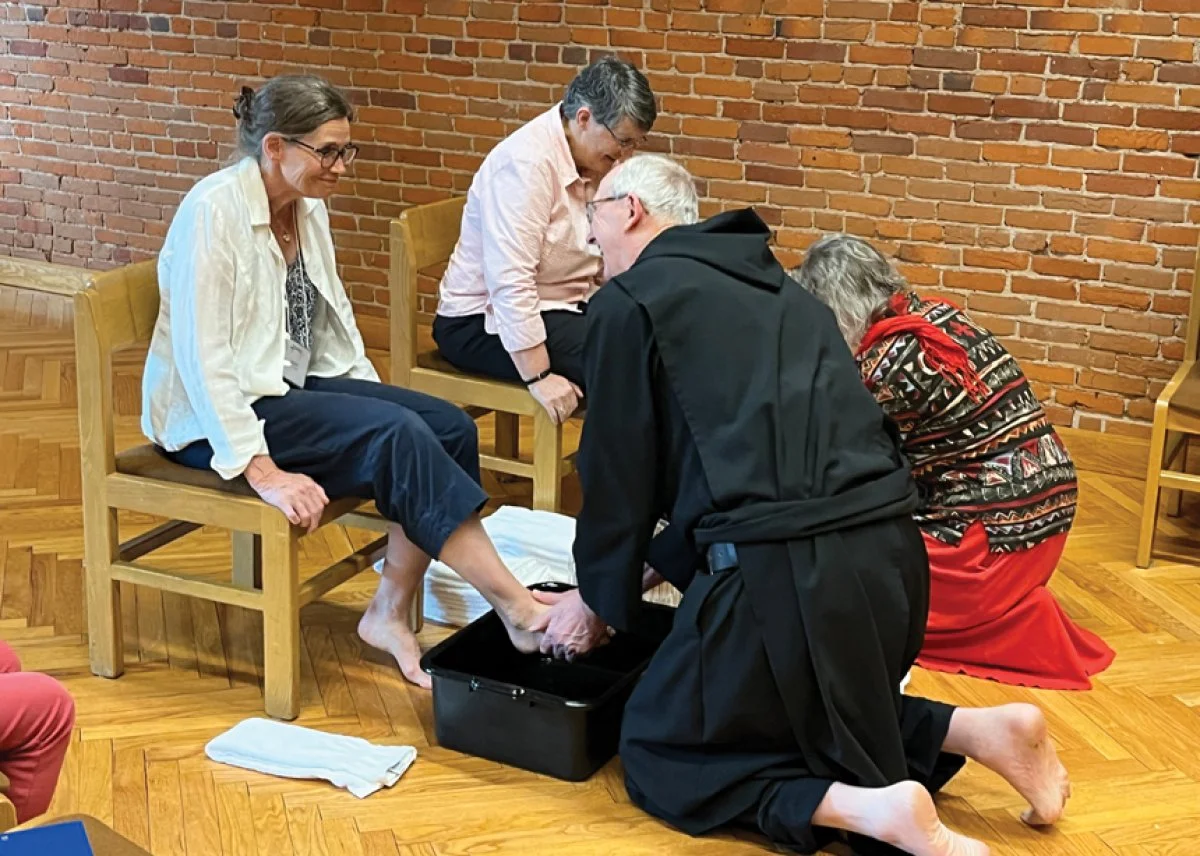
Fr. John Klassen washes the feet of Rachel Reesor-Taylor during the Bridgefolk conference at Saint John’s Abbey in Minnesota. Photo: Gerald Schlabach. (2 Feb. 2024)


Abbot and Professor Examine Anabaptist History
— Oct. 24, 202524 oct. 2025Since 1999, the Bridgefolk movement has brought together peace-minded Catholics and sacramentally minded Mennonites from the U.S. and Canada for an annual gathering. In July, approximately 30 Bridgefolk participants met at First Mennonite Church in Winnipeg for worship, connection and keynote presentations by Jennifer Otto and Father John Klassen on “Anabaptism at 500: Ecumenical Dialogue in an Age of Polarization.”
Otto, a historian who teaches Religious Studies at the University of Lethbridge and who attends Lethbridge Mennonite Church, drew on her trip to Zurich for the 500-year commemorations, highlighting the moment during the main service in the Grossmünster church during which “hecklers” spoke up in the fashion of early Anabaptists.
“The hecklers issued an apology on behalf of our ancestors for the sins of arrogance and self-satisfaction, of being unwilling to compromise and engage with different points of view,” Otto said. “It was clear … we were making no claim that our church, or its founders, had done everything right.”
Representatives of 13 global communions and three ecumenical organizations were present in a place “where enmity once reigned.” Of that enmity, Otto said, “One could tell the story of early Anabaptism as a rejection of Christian unity…. Their contemporary critics accused them of being elitest, self-righteous, quite literally ‘holier than thou.’ And they might have had a point.”
The Dutch Anabaptist movement split into competing groups within its first generation.
Otto offered three lessons about polarization from history. First, humility. Second, “Be aware of the challenge of the ‘near other.’ We tend to be most troubled not by people who are very different from us but by people or groups who are similar to us.”
Thirdly, Otto said, assume your adversary is disagreeing in good faith, even though they might not be. “[It is] too easy to simply dismiss our adversaries as woefully benighted rubes or villains who are fundamentally different from us.” People whose views we find repulsive are “fellow creatures made in the image of God, not ‘satans disguised as angels of light,’ to use an accusation lobbed at the early Anabaptists by Zwingli.”
Father Klassen—who does not have Mennonite roots—is the former abbot of Saint John’s Abbey in Collegeville, Minnesota, and has been part of Bridgefolk since the early years. He spoke with rigour and clarity about Anabaptist history and the evolving Catholic response.
The initial response was the Imperial Diet of 1529, which prescribed death for Anabaptists. Roughly 2,000–4,000 Anabaptists were executed in the following 150 years. In that context, Klassen asks: “Is the Church a learning Church?”
He pointed to the 1929 creation of Vatican City, which decoupled the papacy from civil authority, a fundamental point of contention during the Reformation.
Klassen also spoke about Vatican Council II (1962–1965) as a “watershed moment,” which included recognition of baptism as “a sacrament of faith” requiring a community of believers who support the development of faith and Christian practice. Vatican II also marked a shift towards ecumenism and the recognition of gifts in other Christian churches.
In this vein, in 2000, Pope John Paul II, “publicly asked forgiveness for the use of violence by Catholics … towards believers in other Christian traditions,” though he did not specifically name Anabaptists.
Klassen also highlighted the extent to which both Pope Francis and Pope Leo XIV value nonviolence.
Most recently, at the Anabaptism at 500 service in Zurich, Cardinal Kurt Koch read a lengthy message from Pope Leo XIV.
Despite significant, ongoing theological differences, Klassen says, the Catholic response to Anabaptists has moved from “condemnation and persecution to dialogue, mutual respect and collaboration in the pursuit of peace.”
“We have been a learning church,” he said.
He credits the Anabaptist witness with “help[ing] to catalyze a profound transformation in Catholic teaching, challenging the Church to embrace a more radical commitment to the gospel of peace.”
Klassen expressed his “earnest hope” that the Catholic Church will issue “a direct and humble request for forgiveness” to Anabaptists and prays that churches that emerged from the reformations can “establish fundamental unity with the Catholic Church,” while still maintaining their traditions.
“We need to take seriously the fact that we are already one in the risen Christ because of our baptism,” Klassen said. “That unity is a fact, whether we recognize it or not. We need creative ways to give expression to that unity.
Bridgefolk serves as just such an expression on a grassroots level.
 Posted: Oct. 24, 2025 •
  Permanent link: ecumenism.net/?p=14666
Categories: News • In this article: Bridgefolk, dialogue, Mennonite
Transmis : 24 oct. 2025 • Lien permanente : ecumenism.net/?p=14666
Catégorie : News • Dans cet article : Bridgefolk, dialogue, Mennonite